colorizer.lua
A high-performance color highlighter for Neovim with no external dependencies. Written in performant Luajit.
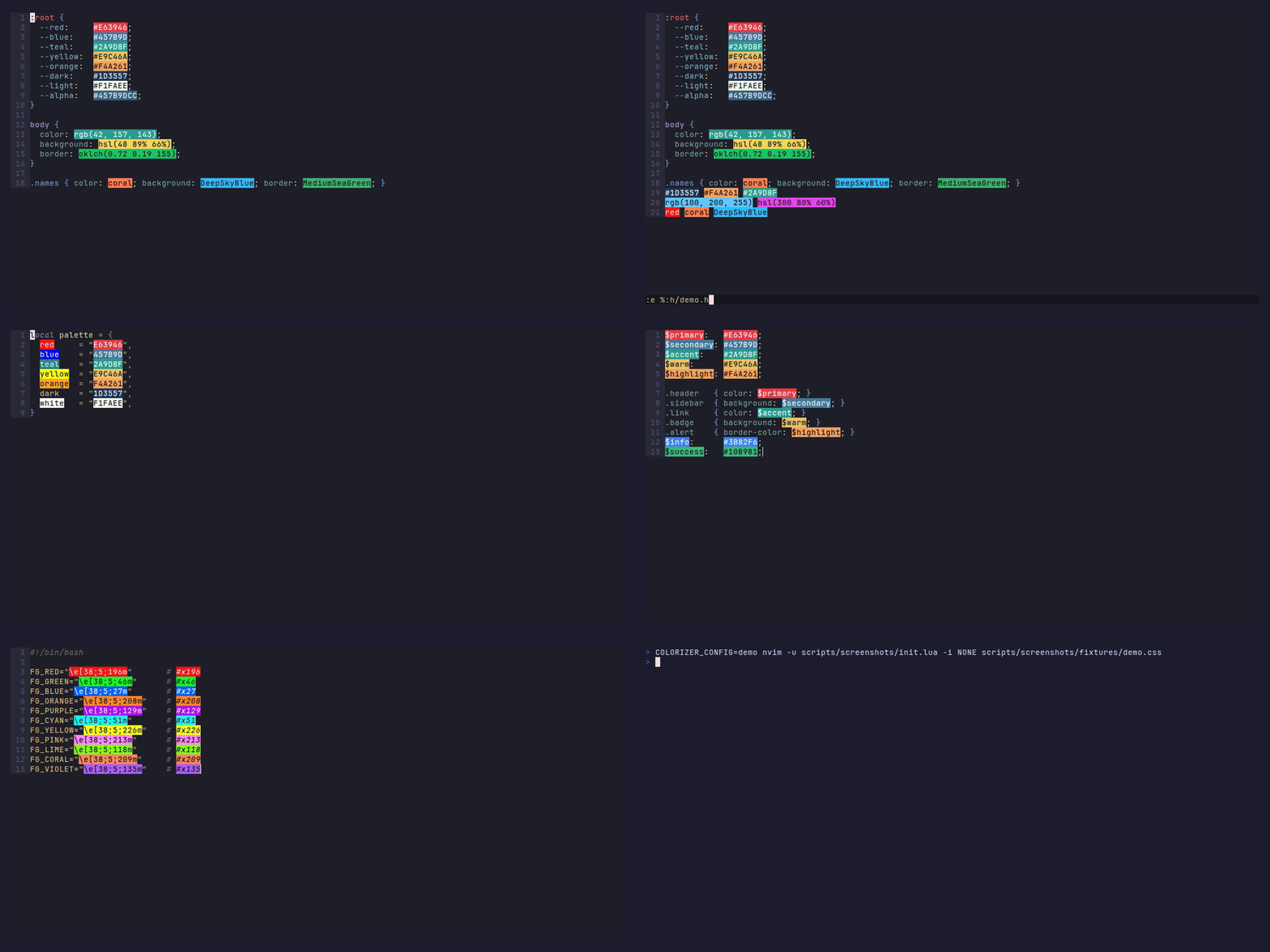
Screenshot tests — CI-generated visual tests for
every parser and display mode. If something looks off, click the [N] link
next to the test to report an issue.
Why colorizer.lua?
- Fast: Handwritten trie-based parser with byte-level dispatch. Only visible lines are processed.
- Zero dependencies: As long as you have
malloc()andfree(), it works (Linux, macOS, Windows). - Broad format support: Hex (
#RGB,#RRGGBB,#RRGGBBAA,#AARRGGBBQML,0xAARRGGBB), CSS functions (rgb(),hsl(),hwb(),lab(),lch(),oklch(),color()), CSS custom properties (var(--name)), named colors, xterm/ANSI 256, Tailwind CSS, Sass variables, and custom parsers — in any filetype. - Display modes: Background (with auto-contrast text), foreground, underline (colored via
sp), and virtualtext (inline or end-of-line). - Higher priority than treesitter: Uses
vim.hl.priorities(diagnostics/user) so colorizer highlights always win over treesitter syntax colors.
Installation
Requires Neovim >= 0.10.0 and set termguicolors
-- vim.pack
vim.pack.add({
    "https://github.com/catgoose/nvim-colorizer.lua"
    })
require("colorizer").setup()
-- lazy.nvim
{
    "catgoose/nvim-colorizer.lua",
    event = "BufReadPre",
    opts = {},
}
Examples
-- Enable all CSS color formats
require("colorizer").setup({
  options = { parsers = { css = true } },
})

-- CSS functions only, with virtualtext display
require("colorizer").setup({
  options = {
    parsers = { css_fn = true },
    display = {
      mode = "virtualtext",
      virtualtext = { position = "after" },
    },
  },
})

-- Preset with individual override
require("colorizer").setup({
  options = {
    parsers = { css = true, rgb = { enable = false } },
  },
})

-- Per-filetype overrides
require("colorizer").setup({
  options = {
    -- base options applied to every filetype unless overridden below
    parsers = {
      hex = { default = false },
      names = { enable = false },
      tailwind = { enable = false },
    },
  },
  filetypes = {
    "*",
    "!markdown",                          -- exclude markdown entirely
    html = { mode = "foreground" },       -- legacy flat key
    cmp_docs = { always_update = true },  -- legacy flat key
    -- Each entry can also use the same nested format as options,
    -- deep-merged on top of the base options:
    css = {
      parsers = {
        hex = { default = true },
        oklch = { enable = true },
      },
    },
    javascriptreact = {
      parsers = { tailwind = { enable = true, lsp = true } },
    },
  },
  buftypes = {
    -- Same override format works for buftypes
    terminal = { parsers = { hex = { default = true } } },
  },
})

-- Enabling a parser per-filetype: both shapes below are valid
require("colorizer").setup({
  options = {
    parsers = { names = { enable = false } }, -- disabled by default
  },
  filetypes = {
    html = { names = true },                                               -- legacy flat shorthand
    css  = { parsers = { names = { enable = true, lowercase = false } } }, -- nested new-format
  },
})
Each value in
filetypes/buftypesaccepts either the nested format (parsers = {...},display = {...},hooks = {...},always_update) or legacy flat keys (mode,names,RGB,rgb_fn, …). Both shapes are translated and deep-merged onto the baseoptions, so you only need to specify what changes for that filetype.This mixed-format compatibility is intentional for
filetypes/buftypesoverrides even though the top-level recommended shape isoptions = { ... }— it lets short per-filetype tweaks stay terse.In summary
- flat legacy parser keys (
names,RGB,rgb_fn, …) go directly on the filetype table, e.g.html = { names = true }- structured parser config goes **under
parsers**, e.g.html = { parsers = { names = { enable = true } } }- to tweak sub-options (
lowercase,camelcase, …) use the nested form — the flat shorthand only togglesenable
Parser options
Hex default key
The default key in parsers.hex sets the default value for all format
keys (rgb, rgba, rrggbb, rrggbbaa, aarrggbb). Any format key you
don't set explicitly inherits from default. Keys you set explicitly always
take priority.
-- Enable all hex formats
hex = { default = true }

-- Enable all hex formats except 8-digit (#RRGGBBAA)
hex = { default = true, rrggbbaa = false }

-- Disable all hex formats
hex = { default = false }

-- Only enable 6-digit hex
hex = { rrggbb = true }

-- Equivalent to the above (default is already false)
hex = { default = false, rrggbb = true }
Note: Other parsers (
names,tailwind,sass) useenableas a simple on/off switch. Thedefaultkey is unique tohexbecause it is the only parser with multiple boolean format sub-keys.
Custom named colors
parsers.names.custom adds user-defined name-to-hex mappings on top of the
built-in CSS names. Pass a table, or a function returning a table for dynamic
loading. Enabling xcolor lets the same custom names work in LaTeX
name!percent expressions (see
#211).
require("colorizer").setup({
  options = {
    parsers = {
      names = {
        enable = true,
        custom = {
          thesisblue = "#1f4e79",
          accentgreen = "#2e7d32",
        },
      },
      xcolor = { enable = true }, -- LaTeX: thesisblue!30
    },
  },
})
Default configuration
require("colorizer").setup({
  filetypes = { "*" }, -- filetypes to highlight, "*" for all
  buftypes = {}, -- buftypes to highlight
  user_commands = true, -- enable user commands (ColorizerToggle, etc.)
  lazy_load = false, -- lazily schedule buffer highlighting
  options = {
    parsers = {
      css = false, -- preset: enables names, hex, rgb, hsl, oklch, css_var
      css_fn = false, -- preset: enables rgb, hsl, oklch
      names = {
        enable = true, -- enable named colors (e.g. "Blue")
        lowercase = true, -- match lowercase names
        camelcase = true, -- match CamelCase names (e.g. "LightBlue")
        uppercase = false, -- match UPPERCASE names
        strip_digits = false, -- ignore names with trailing digits (e.g. "blue3")
        custom = false, -- custom name-to-hex mappings; table|function|false
        extra_word_chars = "-", -- extra chars treated as part of color name
      },
      hex = {
        default = true, -- default value for unset format keys (see above)
        rgb = true, -- #RGB (3-digit)
        rgba = true, -- #RGBA (4-digit)
        rrggbb = true, -- #RRGGBB (6-digit)
        rrggbbaa = false, -- #RRGGBBAA (8-digit)
        hash_aarrggbb = false, -- #AARRGGBB (QML-style, alpha first)
        aarrggbb = false, -- 0xAARRGGBB
        no_hash = false, -- hex without '#' at word boundaries
      },
      rgb = { enable = false }, -- rgb()/rgba() functions
      hsl = { enable = false }, -- hsl()/hsla() functions
      oklch = { enable = false }, -- oklch() function
      hwb = { enable = false }, -- hwb() function (CSS Color Level 4)
      lab = { enable = false }, -- lab() function (CIE Lab)
      lch = { enable = false }, -- lch() function (CIE LCH)
      css_color = { enable = false }, -- color() function (srgb, display-p3, a98-rgb, etc.)
      tailwind = {
        enable = false, -- parse Tailwind color names
        update_names = false, -- feed LSP colors back into name parser (requires both enable + lsp.enable)
        lsp = { -- accepts boolean, true is shortcut for { enable = true, disable_document_color = true }
          enable = false, -- use Tailwind LSP documentColor
          disable_document_color = true, -- auto-disable vim.lsp.document_color on attach
        },
      },
      sass = {
        enable = false, -- parse Sass color variables
        parsers = { css = true }, -- parsers for resolving variable values
        variable_pattern = "^%$([%w_-]+)", -- Lua pattern for variable names
      },
      xterm = { enable = false }, -- xterm 256-color codes (#xNN, \e[38;5;NNNm)
      ls_colors = { enable = false }, -- LS_COLORS/SGR snippets (e.g. =38;5;196, =48;2;0;0;255)
      xcolor = { enable = false }, -- LaTeX xcolor expressions (e.g. red!30)
      hsluv = { enable = false }, -- hsluv()/hsluvu() functions
      css_var_rgb = { enable = false }, -- CSS vars with R,G,B (e.g. --color: 240,198,198)
      css_var = {
        enable = false, -- resolve var(--name) references to their defined color
        parsers = { css = true }, -- parsers for resolving variable values
      },
      custom = {}, -- list of custom parser definitions
    },
    display = {
      mode = "background", -- string or list: "background"|"foreground"|"underline"|"virtualtext"
      background = {
        bright_fg = "#000000", -- text color on bright backgrounds
        dark_fg = "#ffffff", -- text color on dark backgrounds
      },
      virtualtext = {
        char = "■", -- character used for virtualtext
        position = "eol", -- "eol"|"before"|"after"
        hl_mode = "foreground", -- "background"|"foreground"
      },
      priority = {
        default = 150, -- extmark priority for normal highlights
        lsp = 200, -- extmark priority for LSP/Tailwind highlights
      },
      disable_document_color = true, -- true (all LSPs) | false | { lsp_name = true, ... }
    },
    hooks = {
      should_highlight_line = false, -- function(line, bufnr, line_num) -> bool
      should_highlight_color = false, -- function(rgb_hex, parser_name, ctx) -> bool
      transform_color = false, -- function(rgb_hex, ctx) -> string
      on_attach = false, -- function(bufnr, opts)
      on_detach = false, -- function(bufnr)
    },
    always_update = false, -- update highlights even in unfocused buffers
    debounce_ms = 0, -- debounce highlight updates (ms); 0 = no debounce
  },
})
Tailwind CSS
Tailwind colors can be parsed from the bundled color data (enable) or via textDocument/documentColor from the Tailwind LSP (lsp). Both can be used together.
| Option | Behavior |
|---|---|
enable = true |
Parse standard Tailwind color names |
lsp = true |
Use Tailwind LSP document colors |
Both true |
Combine both sources |
lsp accepts a boolean shorthand or a table for fine-grained control:
require("colorizer").setup({
  options = {
    parsers = {
      tailwind = { enable = true, lsp = true },
    },
  },
})
require("colorizer").setup({
  options = {
    parsers = {
      tailwind = {
        enable = true,
        lsp = {
          enable = true,
          disable_document_color = true, -- default
        },
        update_names = true,
      },
    },
  },
})
With lsp.update_names = true and both enable + lsp.enable active, LSP
results are fed back into the name parser's color table. Name-based parsing is
instant (works in cmp windows, new buffers, etc.) but uses bundled color data.
The LSP is slower (requires server response) but reads custom colors from
tailwind.config.{js,ts}. By combining both, buffers are painted immediately
with name-based matches, then LSP results correct the colors and update the
name table so subsequent name-based highlights use accurate values.

Neovim built-in LSP document colors (0.12+)
Neovim 0.12+ has built-in textDocument/documentColor support via
vim.lsp.document_color that is enabled by default on LspAttach. This
can cause duplicate highlights — for example, background highlighting on hex
codes even when colorizer is set to virtualtext mode.
Colorizer automatically disables vim.lsp.document_color on buffer attach via
display.disable_document_color (default true). This applies to all LSP
servers, not just Tailwind. No manual LspAttach autocmd is needed.
disable_document_color accepts three forms:
| Value | Behavior |
|---|---|
true |
Disable document color for all LSP servers (default) |
false |
Keep vim.lsp.document_color active |
{ lsp_name = true, ... } |
Disable only for the listed servers |
Additionally, when tailwind.lsp is active, the Tailwind-specific
tailwind.lsp.disable_document_color (also default true) handles the case
where the Tailwind LSP attaches after colorizer.
To keep the built-in feature active alongside colorizer:
require("colorizer").setup({
  options = {
    display = {
      disable_document_color = false, -- keep vim.lsp.document_color active
    },
  },
})
To disable only for specific LSP servers:
require("colorizer").setup({
  options = {
    display = {
      disable_document_color = { cssls = true, html = true },
    },
  },
})
Or use the built-in feature instead and disable colorizer's LSP integration:
-- Let Neovim handle LSP colors, colorizer handles everything else
require("colorizer").setup({
  options = {
    parsers = {
      tailwind = { enable = true, lsp = false },
    },
  },
})
The built-in vim.lsp.document_color.enable() supports style options:
'background' (default), 'foreground', 'virtual', or a custom string/function.
See :help vim.lsp.document_color.enable() for details.
Note: This only applies to Neovim 0.12+. Neovim 0.10 and 0.11 do not have this feature and are unaffected.
Combined display modes
display.mode accepts a list to apply multiple modes simultaneously:
require("colorizer").setup({
  options = {
    display = {
      mode = { "background", "virtualtext" }, -- colored background + color swatch
    },
  },
})
Non-virtualtext modes (background, foreground, underline) merge into a
single extmark since their highlight attributes don't overlap. virtualtext
always gets its own extmark. Any combination of the four modes is valid.
Note:
backgroundandforegroundboth set thefgattribute. When combined,backgroundwins (auto-contrast text is needed for readability). Usebackground+underlineif you want both effects.
Highlight priority
Colorizer uses extmark priorities from display.priority to control which
highlights win when multiple sources target the same range:
| Key | Default | Based on | Purpose |
|---|---|---|---|
default |
150 | vim.hl.priorities.diagnostics |
Normal parser-based highlights |
lsp |
200 | vim.hl.priorities.user |
Tailwind LSP highlights |
These defaults are higher than treesitter (100) and semantic tokens (125), so colorizer highlights always win over syntax highlighting. The LSP priority is higher than default so Tailwind LSP results take precedence over parser-based matches on the same range.
Neovim's built-in vim.lsp.document_color sets no explicit priority on its
extmarks (effectively 0), so if both are active on the same buffer you get
duplicate highlights rather than a priority conflict. This is why
disable_document_color defaults to true — it prevents the duplicates
entirely.
To customize priorities:
require("colorizer").setup({
  options = {
    display = {
      priority = {
        default = 50, -- lower than treesitter, color highlights lose
        lsp = 300, -- higher than default user priority
      },
    },
  },
})
Custom parsers
Register custom parsers to highlight application-specific color patterns:
require("colorizer").setup({
  options = {
    parsers = {
      custom = {
        {
          name = "android_color",
          prefixes = { "Color." },
          parse = function(ctx)
            local m = ctx.line:match('^Color%.parseColor%("#(%x%x%x%x%x%x)"%)', ctx.col)
            if m then
              return #'Color.parseColor("#xxxxxx")', m:lower()
            end
          end,
        },
      },
    },
  },
})
Each custom parser supports: name, parse(ctx), prefixes, prefix_bytes, setup(ctx), teardown(ctx), state_factory(). See the full documentation for details.
Tip: A custom parser can declare
prefixes = { "=" }(or any other trigger) and validate the rest inparse. To reuse the xterm 256-color palette without copying it, callrequire("colorizer.parser.xterm").lookup_256(idx)orrequire("colorizer.parser.xterm").get_palette(). The built-inls_colorsparser already covers=38;5;NNN/=48;5;NNNand=38;2;R;G;B/=48;2;R;G;Bsnippets.
Hooks
should_highlight_line is called before each line is parsed. Return true to highlight, false to skip:
require("colorizer").setup({
  options = {
    hooks = {
      should_highlight_line = function(line, bufnr, line_num)
        return string.sub(line, 1, 2) ~= "--"
      end,
    },
  },
})
should_highlight_color is called after a color is parsed. Return false to skip that color:
hooks = {
  should_highlight_color = function(rgb_hex, parser_name, ctx)
    -- Skip black and white
    return rgb_hex:lower() ~= "000000" and rgb_hex:lower() ~= "ffffff"
  end,
}
transform_color remaps the color before display:
hooks = {
  transform_color = function(rgb_hex, ctx)
    -- Desaturate: convert everything to grayscale
    local r = tonumber(rgb_hex:sub(1, 2), 16)
    local g = tonumber(rgb_hex:sub(3, 4), 16)
    local b = tonumber(rgb_hex:sub(5, 6), 16)
    local gray = math.floor(0.299 * r + 0.587 * g + 0.114 * b)
    return string.format("%02x%02x%02x", gray, gray, gray)
  end,
}
on_attach and on_detach are called when colorizer attaches to or detaches from a buffer:
hooks = {
  on_attach = function(bufnr, opts)
    vim.notify("Colorizer attached to buffer " .. bufnr)
  end,
  on_detach = function(bufnr)
    vim.notify("Colorizer detached from buffer " .. bufnr)
  end,
}
CSS custom properties
The css_var parser resolves var(--name) references by scanning the buffer
for --name: <color> definitions. Any color format recognized by the configured
parsers (hex, rgb, hsl, etc.) works in definitions.
require("colorizer").setup({
  options = {
    parsers = {
      css = true, -- also enables css_var via the css preset
    },
  },
})
Or enable it explicitly without the full css preset:
require("colorizer").setup({
  options = {
    parsers = {
      hex = { default = true },
      css_var = { enable = true, parsers = { css = true } },
    },
  },
})
Features:
- Resolves aliased variables:
--alias: var(--base)chains are followed - Handles
var(--name, fallback)syntax (highlights using the definition) - Follows
@importdeclarations to resolve variables from imported CSS files - Re-scans definitions on every text change
Cross-file variable resolution
css_var automatically follows @import declarations to resolve variables
defined in other files. All standard import syntaxes are supported:
@import url("variables.css");
@import url('tokens.css');
@import "theme.css";
Import paths are resolved relative to the current file. Buffer-local definitions always take precedence over imported ones.
Lua API
require("colorizer").attach_to_buffer(0, {
  parsers = { css = true },
  display = { mode = "foreground" },
})
require("colorizer").detach_from_buffer(0)
User commands
| Command | Description |
|---|---|
| **ColorizerAttachToBuffer** | Attach to the current buffer |
| **ColorizerDetachFromBuffer** | Stop highlighting the current buffer |
| **ColorizerReloadAllBuffers** | Reload all highlighted buffers |
| **ColorizerToggle** | Toggle highlighting of the current buffer |
Legacy options
The flat user_default_options format is fully supported and automatically
translated to the new structured format internally. No migration is required.
Important:
- The legacy option set is frozen — no new options will be added to it.
New features (e.g.
hsluv,xcolor,css_var_rgb,css_var,debounce_ms,hex.hash_aarrggbb,hex.no_hash) are only available via the structuredoptionsformat. - If both
optionsanduser_default_optionsare provided,optionswins.
require("colorizer").setup({
  user_default_options = {
    names = true,
    RGB = true,
    RRGGBB = true,
    css = false,
    mode = "background",
    tailwind = false,
  },
})
See :help colorizer.config and the
full documentation for the
legacy-to-new translation mapping.
Testing
make test
make test-file FILE=tests/test_config.lua
Documentation
:help colorizer- Full API docs